
Meat cuts
Argentine Beef Cuts and Their US Equivalents: A Butcher's Guide
Vacío, entraña, tapa de cuadril, matambre: what every Argentine beef cut is called in the US, what to ask your butcher, and when there's no exact match.
By Sebastián MaestreUpdated
Find your cut
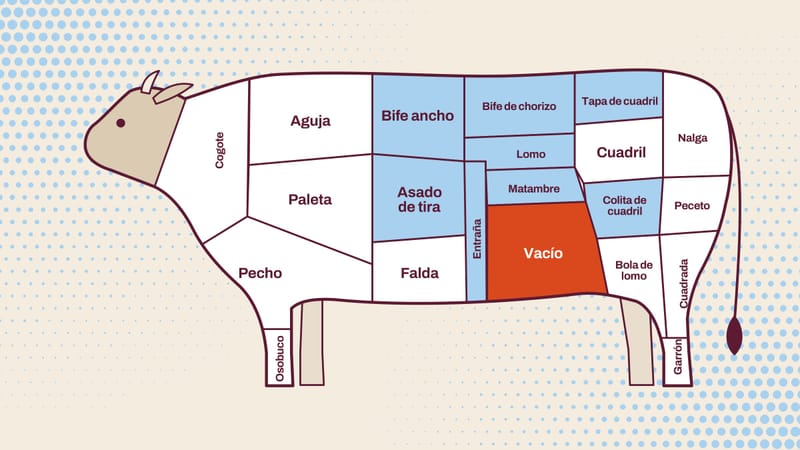
Tap a cut on the map, or search by name, to see what to ask for at a US counter.Each cut on the map links to its row in the table below.
Chart
The Argentine chart
21 cuts. Tap one to see its US name.Selected US primal
Tap a cut or pick one below
The American chart
Tap a primal to see the Argentine cuts inside it.Selected Argentine cut
Tap a cut or pick one below
Every cut, side by side
| Argentina | Ask for in the US | Match | Notes |
|---|---|---|---|
| From the US chuck primal | |||
| Cogote | Beef neck | Close match | Neck meat. Lean but sinewy; used for stews and puchero. US butchers usually grind it, so you may need to ask. |
| Aguja | Chuck roll / chuck eye | Close match | Upper chuck beside the first ribs. Well marbled; slow-grilled or braised. |
| Paleta | Shoulder clod | Close match | Shoulder muscle. Braised, roasted, or sliced for milanesas. |
| From the US brisket primal | |||
| Pecho | Whole brisket (point and flat) | Close match | Breast meat with a thick fat cover. Slow-cooked on the parrilla or braised. |
| From the US shank primal | |||
| Osobuco | Cross-cut beef shank | Exact match | Shank sliced across the bone with the marrow in the center. For braises and soups. |
| From the US rib primal | |||
| Bife anchoOjo de bife (boneless) | Ribeye steak | Exact match | The rib section, cut into thick steaks. Well marbled, with a fat cap the parrillero leaves on. |
| Asado de tiraTira de asado | Flanken-cut short ribs | Close match | Ribs sawn across the bone into long strips. The centerpiece of a Sunday asado. Ask for flanken-style short ribs 3/4 to 1 inch thick. Spans the rib and plate primals. |
| From the US plate primal | |||
| Falda | Plate short ribs | Close match | Belly ribs with more fat and cartilage. For puchero, stews and the slow side of the grill. |
| Entraña | Outside skirt steak | Exact match | The diaphragm muscle. Thin and intensely beefy; cooked fast over high heat. Inside skirt works if outside is unavailable. |
| From the US short loin primal | |||
| Bife de chorizoBife angosto | New York strip | Exact match | Thick-cut strip loin, the classic Argentine steak. Nothing to do with sausage despite the name. |
| Lomo | Tenderloin / filet mignon | Exact match | The tenderest muscle, under the spine. Grilled whole or cut into medallions. Spans the short loin and sirloin primals. |
| From the US sirloin primal | |||
| Tapa de cuadril | Picanha (top sirloin cap, coulotte) | Exact match | The cap of the rump with its fat layer. Brazilian-style shops sell it as picanha. |
| Cuadril | Top sirloin | Close match | Lean, tender hip roast. Grilled whole or sliced into steaks. |
| Colita de cuadril | Tri-tip | Exact match | Small triangular muscle at the bottom of the sirloin. Grilled whole and sliced against the grain. |
| From the US flank primal | |||
| Matambre | Rose meat (elephant ear) | Exact match | A thin layer of meat between the hide and the ribs. Rolled and stuffed for matambre arrollado, or grilled flat. Most US butchers need to special-order it. Spans the flank and plate primals. |
| Vacío | Untrimmed bottom sirloin flap (bavette), or flank steak | No US equivalent | The flank between the last rib and the hip. Juicy and loose-grained; cooked slowly over coals. |
| From the US round primal | |||
| Nalga | Top round | Close match | Lean inside leg. The standard cut for milanesas. |
| Peceto | Eye of round | Exact match | Long, cylindrical and very lean. The cut for vitel toné and pot roasts. |
| Cuadrada | Bottom round flat | Close match | Outside of the leg. Milanesas, braises and roasts. |
| Bola de lomo | Knuckle (sirloin tip) | Close match | Round muscle above the knee. Milanesas, stews and roasts. |
| From the US hind shank primal | |||
| Garrón | Hind shank | Close match | Lower hind leg. Gelatinous; for long braises and caldos. |
If you have ever walked into a US grocery store with an Argentine recipe in hand, you know the problem. The recipe says vacío, the meat case says “flank steak,” and something tells you they are not quite the same thing.
You’re right. Argentina and the US cut a cow in different ways. Argentine butchers follow the natural seams between muscles and keep many of them whole. American butchers split the carcass into primals and portion them with a band saw, so some of our favorite parrilla cuts end up split between two US cuts, or ground into burger trim before they ever reach a store.
This guide is the translation table I wish my family in Chicago had when they started grilling there. For each cut you get the closest US name, the official USDA IMPS number when there is one (butchers and meat suppliers use these), how close the match really is, and exactly what to say at the counter.
How to read this guide
- Exact: the same muscle or the same cut. Buy it with confidence.
- Close: same area of the animal, but trimmed or divided differently. It will work, with small differences.
- Substitute: a different cut that cooks in a similar way. Good for the recipe, not the same meat.
- No equivalent: there is no standard US cut. You will need a special request or a substitute.
The parrilla essentials
These are the cuts you will find at almost every Argentine asado: vacío, asado de tira (we also call it tira de asado), banderita, tapa de asado, entraña, and the classics from the loin and the rump.
| Argentine cut | Ask for in the US | IMPS | Match |
|---|---|---|---|
| Vacío | Untrimmed bottom sirloin flap (bavette), or flank steak | 185A / 193 | No equivalent |
| Asado de tira | Flanken-cut short ribs, cut across the bones | 123A / 130 | Close |
| Banderita | Thin flanken-cut short ribs | 123A / 130 | Close |
| Costillar entero | Whole uncut plate short rib slab | 123 | Close |
| Tapa de asado | Lifter meat (blade meat), or the thin end of a brisket flat | 109B / 120A | Substitute |
| Entraña | Outside skirt steak | 121C | Exact |
| Bife de chorizo | New York strip | 180 | Exact |
| Bife ancho | Bone-in ribeye | 109 family | Exact |
| Ojo de bife | Boneless ribeye | 112A | Exact |
| Lomo | Beef tenderloin | 189 | Exact |
| Tapa de cuadril | Picanha (top sirloin cap, coulotte) | 184D | Exact |
| Colita de cuadril | Tri-tip | 185C | Exact |
| Cuadril | Top sirloin butt | 184 | Close |
| Matambre | Rose meat (also called elephant ear) | none | Exact, but rarely sold |
Vacío: the one everybody gets wrong
Almost every English-language blog translates vacío as “flank steak.” It isn’t. Vacío is a whole slab of the abdominal wall: three layers of muscle plus the fat and membrane on the outside, which we call the cuerito. That outer layer is what keeps vacío juicy during a long, slow cook over embers.
The US system splits that area into separate cuts, and sells them cleaned and trimmed:
- Bottom sirloin flap, also sold as bavette or flap meat (IMPS 185A). This is your best option. It is closest in grain, texture and marbling to the thick part of a vacío. Brazilian markets sell it as fraldinha.
- Flank steak (IMPS 193). Leaner and tighter, more like the thin tip of a vacío. Widely available, but don’t cook it as long: it dries out.
Asado de tira and banderita
Asado de tira is the rib section sawn across the bones, so each strip has four to six small oval pieces of bone in it. In the US, the same cut is sold as flanken-style short ribs, or as LA galbi in Korean markets.
The cutting direction is everything. Regular US “short ribs” are cut parallel to the bone into thick chunks, which is a braising cut and won’t work on the grill. And skip “beef back ribs”: they come from the ribeye section and have very little meat on them.
Korean galbi is usually sliced very thin (around 1/4 inch) and often sold marinated. For an Argentine asado de tira you want it thicker. Banderita, which is especially popular in Buenos Aires, is simply a thinner version of the same cut.
Tapa de asado
Tapa de asado is the flat muscle that covers the outside of the front of the rib cage. It is a classic at the parrilla, though honestly it is a bit drier than vacío or asado de tira, so it rewards a slow fire.
Be careful: many translation charts call it “rib cap.” Rib cap is the spinalis, the tender crown of the ribeye, which is a completely different cut (and much more expensive). The closest US product is lifter meat, also called blade meat (IMPS 109B). If your butcher can’t get it, the thin end of a brisket flat behaves in a similar way.
Entraña
Entraña is the outside skirt steak (IMPS 121C), one of the best matches in this guide. The thicker part of the diaphragm, which some Argentine butchers sell as entraña gruesa, is the US hanger steak (IMPS 140).
Most supermarket “skirt steak” is the inside skirt (121D), which is wider, tougher and chewier. It works in a pinch. Mexican butchers sell skirt as arrachera, but ask which one it is.
Matambre
Matambre is a thin sheet of muscle that sits between the hide and the ribs (anatomists call it the cutaneus trunci). In the US meat trade it is called rose meat or elephant ear, and it is almost always removed at the packing plant and sent to ground beef. You will basically never see it at a regular grocery store.
Your best bet is an independent butcher who breaks down whole sides, or a South American butcher shop. If you can’t find it, butterfly a thick flank steak open like a book and pound it to an even 1/3 inch. It works well for matambre arrollado. In Argentina we usually make it a la pizza, and a flank steak works for that too.
Tapa de cuadril, colita de cuadril and cuadril
These three are often mixed up, and they shouldn’t be:
- Tapa de cuadril = picanha. The cap of the top sirloin, with its thick layer of fat. Brazilian markets and warehouse clubs often carry it. Never let them trim the fat.
- Colita de cuadril = tri-tip. The small triangular muscle, very easy to find on the West Coast.
- Cuadril = top sirloin. The larger piece the other two come from.
The rest of the cow
| Argentine cut | Ask for in the US | IMPS | Match | Notes |
|---|---|---|---|---|
| Cogote | Beef neck | none | Close | For stews. Mexican markets: pescuezo |
| Aguja | Chuck roll or chuck eye | 116A / 116D | Close | Braise or slow-roast |
| Marucha | Whole top blade, with the center gristle | 114D | Exact | Seamed, it becomes two flat iron steaks |
| Paleta | Shoulder clod | 114 | Close | |
| Pecho | Whole brisket, point and flat together | 120 | Close | Divided differently than in Argentina |
| Falda | Short plate, plate ribs | 121 | Close | For puchero and slow cooking |
| Osobuco | Cross-cut beef shank, 1.5 to 2 inches | 117 | Exact | Mexican markets: chambarete |
| Garrón | Hind shank | Close | For puchero | |
| Nalga | Top round | 168 / 169 | Close | For milanesas, sliced 1/4 inch |
| Tapa de nalga | Top round cap | Close | ||
| Peceto | Eye of round | 171C | Exact | Vitel toné, roast beef |
| Cuadrada | Bottom round flat | 171B | Close | Milanesas |
| Bola de lomo | Knuckle (sirloin tip) | 167 | Close | Milanesas, stews |
A note on marucha
The marucha has a thick nerve running right through the middle, and that’s how you recognize it. US butchers sell the same muscle as top blade. When they cut along that nerve and remove it, they get two flat iron steaks, one of the most tender steaks on the animal.
In Argentina we usually cook it whole, nerve and all, slowly enough for it to soften. If you want it the Argentine way, ask for a whole top blade, untrimmed. If you just want a great quick steak, buy flat iron.
Achuras
No asado is complete without achuras, the sausages and offal that come off the grill first while the big cuts are still cooking. Some are easy to find in the US. Others will send you on a small quest.
| Argentine name | US name | Where to find it |
|---|---|---|
| Chorizo parrillero | Fresh Argentine-style sausage | Argentine and South American shops, online |
| Morcilla | Blood sausage | South American, Spanish and British shops, online |
| Mollejas | Sweetbreads (thymus) | Specialty butchers, Latin markets, restaurant suppliers |
| Chinchulines | Beef small intestine | Mexican markets, as tripas de leche |
| Riñón | Beef kidney | Butchers, Latin markets, often frozen |
| Ubre | Beef udder | Mexican markets, as ubre de res |
| Provoleta | Aged provolone | Italian delis, cheese shops, online |
Chorizo parrillero is a fresh, raw sausage of pork and beef, seasoned with wine, garlic and ají molido. It is nothing like Spanish chorizo (cured and smoked) or Mexican chorizo (loose, with vinegar and chili). If you can’t find the Argentine kind, a fresh sweet Italian sausage is the closest substitute.
Mollejas are sweetbreads, and in Argentina you’ll see two kinds, both from the thymus gland. Molleja de corazón, from the chest, is flatter and fattier. Molleja de garganta, from the throat, is plumper and made of little lobes joined together, a bit like a kidney. Both are great on the grill. Avoid anything sold cheaply as “gut sweetbreads”: that’s the pancreas, a completely different organ.
Chinchulines are beef small intestines grilled until crispy. Your best source is a Mexican butcher, where they are sold as tripas de leche, the same thing that goes into tacos de tripa.
Ubre needs to be simmered in salted water for 45 to 60 minutes before it goes on the grill. Then slice it and finish it over the coals.
Provoleta needs a firm, aged provolone (look for provolone piccante). Regular deli provolone is too young and too wet: it melts through the grates. Cut it in discs 3/4 to 1 inch thick.
Food safety
The USDA recommends cooking organ meats (sweetbreads, kidney, intestines, udder) and fresh sausages to an internal temperature of 160°F (71°C). For whole cuts like steaks and roasts, the minimum is 145°F (63°C) followed by a three-minute rest. Morcilla is usually sold pre-cooked, but check the package, and warm it gently on the edge of the grill so the casing doesn’t burst.
How to get Argentine cuts in the US
My family lives in Chicago, and after a lot of trial and error their advice is always the same: make friends with your butcher. A good independent butcher who breaks down whole animals can cut almost anything if you explain it well. If you buy a larger quantity, like a whole side of beef shared with friends, it’s much easier to convince them to cut some pieces the Argentine way.
A few more tips:
- Look for South American butcher shops. Many US cities have Argentine, Uruguayan or Brazilian butchers that sell our cuts by name. Brazilian shops are great for picanha, fraldinha and tri-tip.
- Mexican carnicerías are underrated. They are your best source for offal, shanks, skirt and thin cuts.
- Bring a photo and the US name. Show the butcher a picture of the cut you want and tell them how thick, with or without bone, and with the fat left on.
- Say “untrimmed.” US butchers are trained to remove fat and membrane. For Argentine grilling you usually want them left on.
Why it’s not just about the cut
Even with the perfect cut, an Argentine asado tastes different because of how we cook it. American grilling tends to sear the meat over very high heat: a dark crust outside, red in the middle, done in minutes. At an Argentine parrilla we cook over a bed of embers at a much gentler heat, for much longer. The meat cooks more evenly from edge to center and holds on to its juices.
So once you find your vacío or your asado de tira, give it time. That’s the other half of the translation.

Sebastián Maestre
Co-founder, savory recipes
Sebastián is a concert photographer and web developer from Córdoba, Argentina, and the one in charge of the fire. He writes the savory side of the site: asado, empanadas, sauces and the cuts of beef behind Argentine grilling.
