Meat cuts
Argentine Pork Cuts and Their US Equivalents: A Butcher's Guide
Bondiola, matambrito, pechito, panceta: what each Argentine pork cut is called in the US, what to ask your butcher, and the fresh vs cured trap.
By Sebastián MaestreUpdated
Find your cut
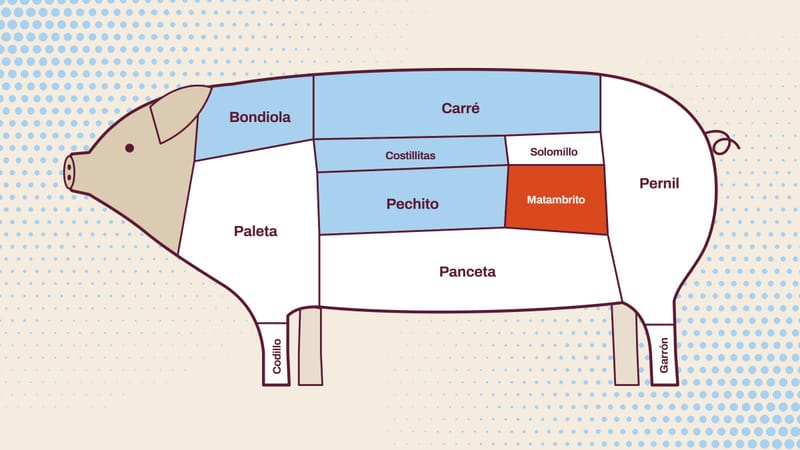
Tap a cut on the map, or search by name, to see what to ask for at a US counter.Each cut on the map links to its row in the table below.
Chart
The Argentine chart
12 cuts. Tap one to see its US name.Selected US primal
Tap a cut or pick one below
The American chart
Tap a primal to see the Argentine cuts inside it.Selected Argentine cut
Tap a cut or pick one below
Every cut, side by side
| Argentina | Ask for in the US | Match | Notes |
|---|---|---|---|
| From the US Boston butt primal | |||
| Bondiola | Pork collar (fresh coppa) | Close match | The neck and upper shoulder muscle, sold boneless as a long, marbled log. Grilled whole, roasted or sliced for sandwiches. A Boston butt includes it, plus the blade bone. |
| From the US picnic shoulder primal | |||
| Paleta | Fresh picnic shoulder | Close match | Shoulder roast for braising or slow roasting. Ask for it boneless if you plan to stuff and roll it. |
| From the US loin primal | |||
| Carré | Bone-in pork loin (center-cut rack) | Exact match | The loin with its rib bones. Roasted whole or cut into bone-in chops (costeletas). |
| Lomo de cerdo | Boneless pork loin | Exact match | The loin eye without the bone. Roasted, grilled in thick slices, or cut thin for milanesas. |
| Costillitas | Baby back ribs | Close match | Rib bones from the top of the carré, with the meat between them. Cooked slowly over coals. |
| Solomillo | Pork tenderloin | Exact match | Small, lean and tender, from under the spine. Cook it fast and take it off while it is still slightly pink. |
| From the US belly primal | |||
| PechitoPechito de cerdo | Whole spareribs, untrimmed (not St. Louis cut) | Close match | The rib section of the belly, with a layer of meat and fat on the bones. The pork star of the parrilla. |
| MatambritoMatambre de cerdo | No standard cut — special order | No US equivalent | A thin, flat muscle between the skin and the ribs. Grilled fast, often finished a la pizza. Few US butchers separate it, so ask ahead of time. |
| Panceta | Fresh pork belly | Exact match | Belly with layers of fat and meat. Grilled in thick strips or braised. Cured or smoked panceta is closer to US bacon. |
| From the US leg primal | |||
| Pernil | Fresh ham (whole leg) | Exact match | The whole hind leg, slow-roasted for parties and sliced for sandwiches de pernil. In the US, ask for fresh (uncured) ham. |
| From the US front hock primal | |||
| Codillo | Fresh front hock | Exact match | Lower front leg with skin and bone. Braised, or added to stews and lentejas. |
| From the US ham hock primal | |||
| GarrónGarrón de cerdo | Fresh hind hock | Exact match | Lower hind leg, meatier than the front hock. Braised or used in soups. US ham hocks are usually smoked, so ask for fresh. |
Pork is easier to translate than beef, but it has two traps that can ruin an Argentine recipe: cuts that the US divides differently (bondiola, matambrito, pechito), and the fact that American stores sell so much pork already cured or smoked. If an Argentine recipe calls for panceta or pernil, the bacon or the holiday ham in your grocery store is not what you want.
Here is the full translation, with the closest US name, the USDA IMPS number when there is one, how good the match is, and what to say at the counter. If you haven’t read it yet, our Argentine beef cuts guide works the same way.
How to read this guide
- Exact: the same cut. Buy it with confidence.
- Close: same area, trimmed or divided differently.
- Substitute: a different cut that cooks in a similar way.
- No equivalent: no standard US cut exists.
Argentine pork cuts at a glance
| Argentine cut | Ask for in the US | IMPS | Match |
|---|---|---|---|
| Bondiola | Pork collar (fresh coppa); Boston butt as a substitute | none (Boston butt: 406A) | Close |
| Paleta | Fresh picnic shoulder | 405 | Close |
| Carré | Bone-in pork loin (center-cut rack) | 410 / 412 | Exact |
| Lomo de cerdo | Boneless pork loin | 413 | Exact |
| Solomillo | Pork tenderloin | 415 | Exact |
| Costillitas | Pork ribs, baby back | 422 | Close |
| Pechito | Whole spareribs, untrimmed (not St. Louis cut) | 416 | Close |
| Matambrito | No standard cut; sometimes sold as “pork flank” | none | No equivalent |
| Panceta (fresh) | Fresh pork belly, uncured | 408 / 409 | Exact |
| Pernil | Fresh ham (fresh pork leg) | 401 | Exact |
| Codillo | Fresh front hock (shoulder hock) | Exact | |
| Garrón | Fresh hind hock | Exact |
Lomo or solomillo? The classic mistranslation
Dictionaries often translate lomo de cerdo as “pork tenderloin.” In Argentina it isn’t. At any butcher in Argentina, lomo de cerdo is the boneless loin, the big wide muscle along the back (what we call carré when it still has the bones). The solomillo is the long, thin strip that sits under the spine: that’s the US pork tenderloin.
They cook very differently. A pork loin is a roast; a tenderloin is a quick-cooking cut that weighs about a pound. If an Argentine recipe says lomo de cerdo and you buy tenderloin, your cooking times will be all wrong.
Bondiola
Bondiola is the neck muscle of the pig: a long, cylindrical, beautifully marbled piece. It’s the same muscle Italians cure to make coppa, and American barbecue competitors call it the “money muscle.”
In the US it’s sold as pork collar or fresh coppa, but mostly at specialty butchers. What every supermarket does have is the Boston butt, a bigger cut of the upper shoulder that contains the bondiola plus several other muscles. It works fine for braising, but it isn’t the same piece.
Here’s the good news: you can get a bondiola out of a boneless Boston butt yourself. Look for the cylindrical, marbled muscle running along one side of the butt, and follow the natural fat seam around it with a sharp knife. It lifts out in one piece, usually 3 to 4 pounds.
Ribs: costillitas and pechito
Costillitas are a rack of ribs, the kind you see in every American barbecue movie. The closest US cut is baby back ribs (IMPS 422), the ribs from the top of the rib cage, next to the loin.
Pechito is the lower part of the rib cage, with its cartilage at the end and a generous layer of belly meat on top (we call it pechito con manta). In the US that’s whole spareribs (IMPS 416). The important word is whole: many stores sell spareribs already trimmed “St. Louis style,” with the cartilage and the flap of meat cut off. Those are exactly the parts that make pechito so good on the grill.
Matambrito: the hardest one to find
Matambrito is a thin, boneless cut from the outside of the rib section, between the skin and the ribs. It’s juicy, cooks fast, and in Argentina we love it grilled with lemon (matambrito al limón).
There is no standard US cut for it. American packing plants usually trim it off and send it to sausage. Some South American and Mexican butchers sell it, sometimes labeled “pork flank” or suadero de cerdo. An independent butcher who works with whole pigs can usually pull it for you if you show them a photo.
Many websites will tell you matambrito is the same as Spanish secreto. It isn’t: secreto comes from the shoulder area, a different part of the pig. But it’s thin, marbled and cooks just as fast, so if you find secreto, it’s a great substitute on the grill. Otherwise, a pork tenderloin butterflied and pounded to 1/3 inch will do the job.
Fresh vs. cured: the trap in the US
In Argentina, when a recipe says panceta, pernil, codillo or garrón, it usually means the fresh cut. In US grocery stores, the same parts of the pig are very often sold cured or smoked: bacon, ham, smoked ham hocks. Use them in an Argentine recipe and the dish comes out pink, salty and smoky.
- Panceta fresca = fresh pork belly. Look for “uncured” and “unsmoked,” and make sure it’s not bacon. Asian markets and warehouse clubs usually carry it.
- Panceta salada or ahumada = bacon (cured, and often smoked). Italian pancetta is also cured.
- Pernil = fresh ham or fresh pork leg, raw and uncured. Latin markets sell it as pernil, and many supermarkets can order it, especially around the holidays.
- Codillo and garrón = fresh pork hocks, front and hind. Not smoked ham hocks.
Watch out for “uncured bacon.” Despite the name, it’s still cured, just with celery powder instead of synthetic nitrites. It is not fresh pork belly.
Chorizo and morcilla
Chorizo de cerdo (Argentine-style) is a fresh, raw sausage seasoned with garlic, wine, pepper and ají molido. It is neither the cured Spanish chorizo nor the loose Mexican chorizo. Argentine and South American shops sell it, and you can find it online. If you can’t get it, use a fresh sweet Italian sausage.
Morcilla is blood sausage. Spanish and South American shops are your best source; French boudin noir is a good substitute, British black pudding a less similar one (it’s firmer, with oats). In Argentina you’ll also find morcilla dulce, with raisins and nuts.
Food safety
The USDA minimum for whole pork cuts (loin, chops, tenderloin, shoulder, fresh ham) is 145°F (63°C) followed by a three-minute rest. Fresh sausages like chorizo need 160°F (71°C). Pre-cooked morcilla only needs to be heated through, gently, so the casing doesn’t burst.
Keep in mind these are safety minimums, not the right temperature for every dish. A bondiola braised until it falls apart goes well above 145°F, because that’s what it takes to break down the connective tissue.
Where to buy
- Supermarkets: pork loin, tenderloin, Boston butt, picnic shoulder, baby back ribs, spareribs.
- Asian markets and warehouse clubs: fresh pork belly, sometimes skin-on.
- Latin markets: pernil, fresh hocks, sometimes matambrito and pork collar.
- Independent butchers: anything else, if you ask nicely. My family in Chicago learned that the best thing you can do is make friends with your butcher. Once they know you, they’ll cut things the way you ask.

Sebastián Maestre
Co-founder, savory recipes
Sebastián is a concert photographer and web developer from Córdoba, Argentina, and the one in charge of the fire. He writes the savory side of the site: asado, empanadas, sauces and the cuts of beef behind Argentine grilling.